

Commentary
Olga Loiko
{
  "authors": [
    "Olga Loiko"
  ],
  "type": "commentary",
  "blog": "Carnegie Politika",
  "centerAffiliationAll": "",
  "centers": [
    "Carnegie Endowment for International Peace",
    "Carnegie Russia Eurasia Center"
  ],
  "englishNewsletterAll": "",
  "nonEnglishNewsletterAll": "",
  "primaryCenter": "Carnegie Russia Eurasia Center",
  "programAffiliation": "",
  "regions": [
    "Russia",
    "Belarus"
  ],
  "topics": [
    "Security",
    "Economy",
    "Foreign Policy",
    "Trade"
  ]
}
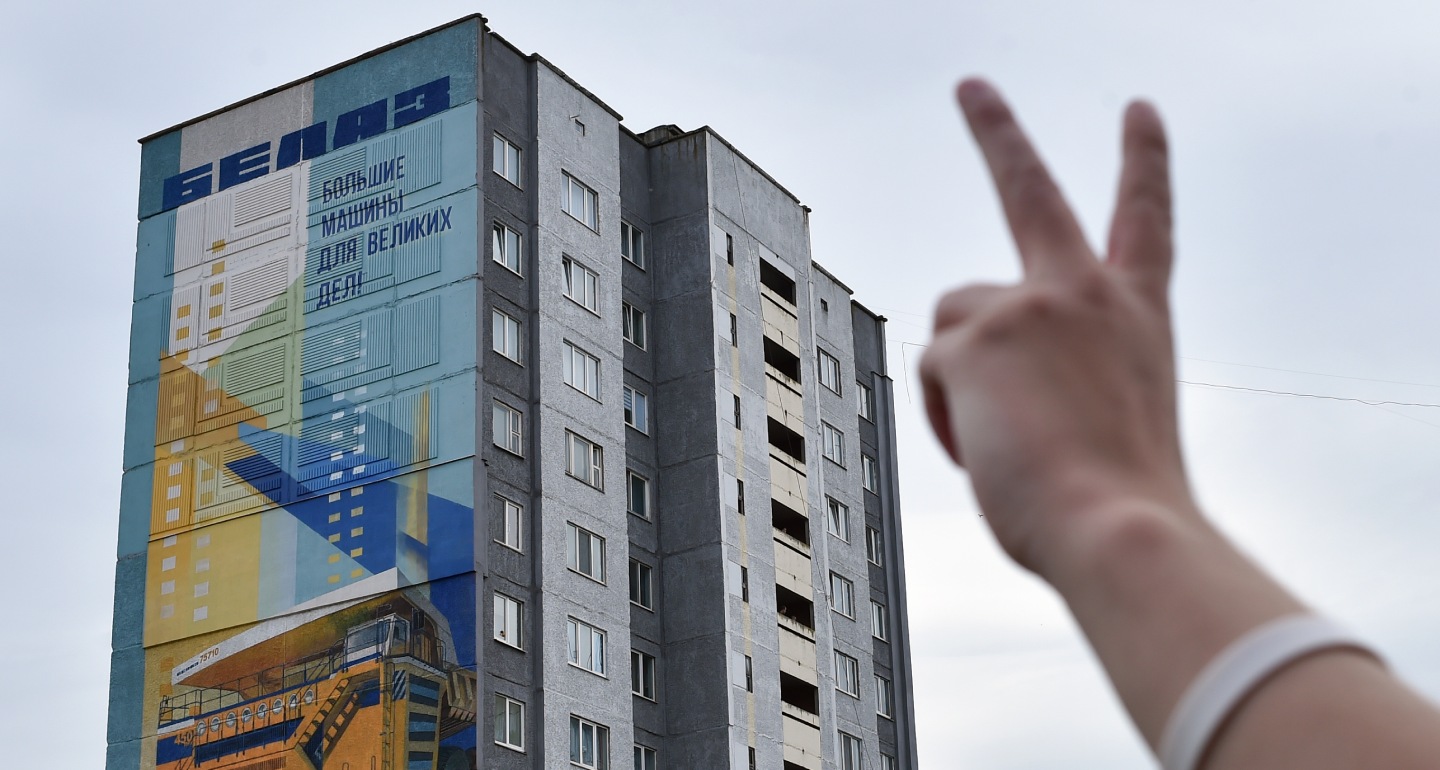
Source: Getty
Minsk’s faith in the future of its larger neighbor’s economy is fading as Belarusian firms in Russia see record losses.
Russia’s decision to spend about a third of its annual budget on waging war against Ukraine created opportunities for the morally unscrupulous: a category that included Belarusian state companies. But the honeymoon period for those companies did not last long, and by 2025 betting on Russia was already looking like a mistake.
Contested Belarusian leader Alexander Lukashenko began signaling in 2024 that Belarusian exports to Russia were facing headwinds. However, given that both countries have stopped publishing their trade statistics, the extent of the problem was hard to assess.
Lukashenko lamented the following year that Belarus had redirected too many exports to the Russian market. He said that the share of Belarusian exports going to Russia—65 percent—had grown so large (up from 45 percent in 2019) that it was becoming a risk. Indeed, in certain sectors it was even higher: Almost 90 percent of exports from Industry Ministry companies and over 70 percent of exports from Agriculture Ministry companies were going to Russia.
“Everyone is crowded into one market in which the situation has changed. It’s no longer 2022, when Western companies fled. Today, the Russian market is oversaturated, and competition is intensifying,” Lukashenko warned.
His words proved to be correct. Belarusian state companies operating in Russia had a disastrous year in 2025. Research by the independent media outlet Plan B looking at the annual reports of forty-three major Belarusian state companies (about 90 percent of the state sector) showed that their Russian distribution networks that year earned a miniscule $6 million.
The combined revenue of the forty-three companies and the sixty-seven entities in their distribution network fell by 17 percent in 2025 to 400 billion Russian rubles ($4.8 billion). In particular, all Belarusian mechanical engineering companies—just like their Russian counterparts—experienced major problems as a result of high interest rates and low demand.
The few Belarusian companies that saw their revenue grow in 2025 included the meat retailer Agrokombinat Dzerzhinskiy, the spirit producer Minsk Kristall Group, and the Minsk Sparkling Wines Factory, along with the Russian subsidiary of the Belarusian Oil Company, which increased gasoline sales, and the electronics manufacturer Integral, which has become a key part of the Russian defense sector.
A look at the profit figures from the Plan B research shows the full extent of the problem, with the total profits of Belarusian state companies in Russia in 2025 falling to 4.1 billion Russian rubles: about a third of the previous year. The most striking data point from 2025, though, was total losses, which increased twenty-four-fold to a total of 3.6 billion Russian rubles. The biggest losses were incurred by the oil producer Belorusneft’s subsidiaries. High production costs, low oil prices, logistical problems, and high taxes meant they recorded the biggest loss ever by a Belarusian oil company: 2.85 billion Russian rubles.
Having assessed the scale of the problem, the question remains: Has rock bottom been reached? Unfortunately for Minsk, there’s little room for optimism, regardless of whether the focus is on entire sectors or specific firms.
Take the oil industry, for example. Minsk has invested in oil production in Russia over several decades: Belorusneft subsidiary Yangpur, which was acquired in 2013, was once a major source of income. In its best years, Yangpur’s profits were between $10 million and $20 million—and in 2024, they hit $35 million. In 2025, however, the company lost $18 million. Another Belorusneft subsidiary, Belorusneft-Siberia, saw losses of $14.5 million the same year. Both suffered from Western sanctions, low oil prices, and high taxes.
The situation is no better for Belarusian car manufacturers. The Minsk Automobile Plant (MAZ) saw truck sales in Russia fall 43 percent in 2025 as the company became caught up in a severe crisis in this sector of the Russian market (where total sales collapsed by 51 percent).
It’s easier for Russian companies to survive because Moscow takes measures to protect its own from the effects of high interest rates and the demands of the defense sector. Belarusian firms are being squeezed out of the Russian market when it comes to elevators, agricultural machinery, and dairy: indeed, any sector where Russia has sufficient production capacity of its own.
In response, Minsk is doing what it can. First and foremost, Belarusian companies are slashing prices, to the point of dumping. As a result, Belarusian sugar producers saw profits plunge 41 percent in 2025 despite revenue rising 12 percent, and the profits of meat processing plant Agrokombinat Dzerzhinskiy dropped 61.5 percent even as revenue leapt 74.5 percent. Lukashenko himself accidentally revealed the approach taken by Belarusian cement manufacturers when he complained that the same cement cost 40 percent less in Russia than in Belarus. Cheese manufacturers have been observed doing the same thing.
Another tactic Belarusian companies could explore would be to diversify exports. But Western sanctions, technological backwardness, and logistical ties to Russia mean this is a challenge for the Belarusian state sector. In addition, new markets in China, other Asian countries, and Africa are primarily interested in buying raw materials and low-tech goods from Belarus.
Minsk is clearly losing faith in the future of the Russian economy, and has been desperately seeking to leverage markets via the BRICS group of countries and the Shanghai Cooperation Organization, flirting with U.S. President Donald Trump, and even looking to the Kremlin’s main ideological foe: the European Union.
Since the full-scale invasion of Ukraine, for which Belarus allowed Russian troops to use its territory, Russia’s actions have created serious political, military, and economic risks for Belarus, without offering much in the way of a reward for its ally’s support. Moscow does provide—as it has done for years—discounts on oil and gas, and it has stationed the intermediate-range hypersonic ballistic missile Oreshnik in Belarus. But it’s becoming increasingly difficult for Minsk to rely on Russia as a creditor of last resort, or as a profitable market for Belarusian goods. Russia is consumed by its own problems, and adequately supporting its ally is not a high priority.

Editor in chief of Belarussian independent media "Plan B"
Editor in chief of Belarussian independent media "Plan B"
Recent Work
Olga Loiko
Reestablishing a dialogue with Moscow is not a goal in its own right. The goal is to guarantee the independence of Ukraine and the peace and security of Europe.
Arkady Moshes
Ukraine’s increasingly confrontational posture on Belarus reflects Kyiv’s effort to shape the emerging regional order in Eastern Europe. Kyiv wants to limit European normalization with Minsk—and any future rapprochement with Russia.

Balázs Jarábik
For all the menacing rhetoric, the Armenian prime minister remains a leader with whom Putin is prepared to interact: not as an ally, but as a partner, albeit a problematic one.

Alexander Atasuntsev
The issue is not that the president only has selective information at his disposal, but that the decision-making process consists of one person with an unshakeable vision of how the world works.

Tatiana Stanovaya

By fueling the arguments of both supporters and opponents of Armenian Prime Minister Nikol Pashinyan, Azerbaijan wants to ensure he is re-elected with a weaker mandate.

Bashir Kitachaev