

Article
Middle powers in the region will keep hedging between Washington and Beijing. It’s in the great powers’ interests to play along.
Amr Hamzawy, Kathryn Selfe
Source: Getty
Strengthening U.S.-Africa trade and advancing U.S. interests aren’t conflicting goals.
The African Growth and Opportunity Act (AGOA) expires on December 31, 2026, and Congress has a steep hill to climb to enact a reformed trade program before the end of the year. U.S. Trade Representative (USTR) Jamieson Greer noted in February that the administration would work to “modernize the program to align with President [Donald] Trump’s America First Trade Policy.”1 A request for public comments issued by the USTR’s office on April 28 signaled the administration’s intent to pivot from a development-minded preference program toward guarantees of preferential market access for U.S. firms, stricter eligibility criteria, more stringent anti-leakage provisions, and carve-outs for national security priorities like critical minerals.2
The Trump administration may be fundamentally misreading Africa’s current geopolitical moment—and America’s own place within it. In today’s “polyamorous” trading order, African policymakers and business leaders are not facing a binary choice as they operationalize the African Continental Free Trade Area (AfCFTA).3 They are managing portfolios of overlapping commercial relationships with the United States, China, the European Union (EU), and an expanding cast of middle powers (all of which are aggressively vying for influence). The United States is already playing catch-up. China has made across-the-board duty-free access to its market, paired with extensive investments in infrastructure, a centerpiece of its economic value proposition; the EU has modernized economic partnership agreements with nineteen African countries and regional blocs; and many other middle powers—including those the United States has traditionally considered its most steadfast trading partners—are looking to Africa as they recalibrate their own diversification strategies.4
As such, the design of the next U.S.-Africa trade regime will play a significant role in determining whether the United States emerges with a stronger strategic foothold on the continent or cedes further ground to competitors. A reformed AGOA that tips toward heavy conditionality—frontloading demands for reciprocal market access and narrowed eligibility, stacked on top of overlapping sectoral tariffs—will read in African capitals as further evidence of Washington’s retreat. This in turn will accelerate the erosion of U.S. influence in Africa’s increasingly dynamic markets at a time when America should be positioning itself as a partner of choice.
The design of the next U.S.-Africa trade regime will play a significant role in determining whether the United States emerges with a stronger strategic foothold on the continent or cedes further ground to competitors.
Looking forward, the strategic question for AGOA renewal under an “America First” trading regime is not whether the United States should drive a harder bargain; it is what kind of bargain will keep African economies oriented toward the U.S. market, U.S. firms and investors, and U.S. supply chains. A smartly designed AGOA 2.0 has the potential to help open African markets to more U.S. firms, secure supply chains that bypass Chinese chokepoints, and provide a signal to U.S. investors that African industrialization is an opportunity, not a threat. But this will require the administration to demonstrate a degree of strategic foresight and restraint that it has heretofore not shown across the full scope of trade actions it has directed at the continent.
Many consider AGOA to have underperformed. However, it has not been an unmitigated failure. AGOA’s track record should be understood in the context of macroeconomic factors beyond its ambit, the varying capacities of African beneficiaries to leverage its benefits, insufficient U.S. investment in Africa to unlock AGOA advantages, and the fuller picture of U.S.-African trade (including U.S. services exports).
USTR’s most recent Biennial Report on the implementation of AGOA, released in 2024, highlights the lackluster state of U.S.-Africa trade. U.S. imports under AGOA have fluctuated considerably, totaling $9.7 billion in 2023, up from $6.8 billion in 2021 but down from $10.2 billion in 2022. This fluctuation reflects a lack of trade diversification; Africa’s export basket to the United States is still dominated by commodities, particularly fossil fuels. Nonetheless, trade diversification has grown in recent years with non-oil exports—including motor vehicles, apparel, ferroalloys, precious jewelry, cocoa products, citrus fruit, and copper—posting 10.6 percent growth in 2023, reaching $5.5 billion.5
Trade trends between the United States and Africa reflect broader structural changes in the global economy that extend well beyond AGOA itself. African economies were never positioned to compete directly with export powerhouses such as Vietnam or Bangladesh, which have benefited from the relocation of large-scale manufacturing from China. At the same time, shifts in global energy markets have reduced the relative importance of African fossil fuel exports to the United States over AGOA’s lifespan. In the first seven years of AGOA’s existence, energy imports dominated the top five U.S. imports from Africa.6 However, the United States expanded its domestic crude oil production, overtaking Russia and Saudi Arabia, to become the top global oil producer in 2018.7 During AGOA’s lifetime, the United States has ramped up oil production from an average of 5.8 million barrels per day in 2000 to a record average of 13.6 million barrels per day in 2025.8 The decline in U.S. demand for energy products from Africa has ultimately led to a more diversified import mix, which is lower in value.9 These macroeconomic dynamics have had a substantial impact on overall U.S.-Africa trade volumes independent of AGOA’s design.
Moreover, AGOA’s uneven track record across the continent also reflects differing levels of political commitment and institutional capacity among African governments.10 Countries that have adopted targeted AGOA utilization strategies, invested in export readiness, and coordinated closely with U.S. partners have generally performed better than those that have not. This suggests that AGOA’s limitations stem not only from the program itself, but also from inconsistent implementation and capacity and institutional deficiencies in the African beneficiary countries. A 2025 Carnegie study of the AGOA utilization of Côte d’Ivoire revealed that some of the challenges facing even the more successful African exporters included the absence of a national strategy for AGOA utilization, low levels of national coordination, low access to trade finance, high personnel turnover in the public sector (which erodes capacity gains), and a lack of resources to maintain functioning AGOA help desks in country.11
Countries that have adopted targeted AGOA utilization strategies, invested in export readiness, and coordinated closely with U.S. partners have generally performed better than those that have not.
Additionally, U.S. public and private investment incentives have often failed to scale rapidly enough to overcome entrenched perceptions of commercial and political risk on the continent. AGOA has indeed improved market access by eliminating tariffs. However, AGOA’s preferences have not been consistently paired with the financing, insurance, infrastructure support, and technical assistance needed to catalyze large-scale investment. Moreover, the perennial threat of annual AGOA eligibility reviews, including out-of-cycle reviews, creates business uncertainty. This disincentivizes long-term foreign direct investment from private investors seeking to leverage AGOA benefits by investing in African enterprises and supply chains.12
For decades, programs under the U.S. Agency for International Development (USAID), the Millennium Challenge Corporation (MCC), and Power Africa have focused on smaller-scale projects supporting the development of infrastructure like roads, ports, and electricity to unlock regional and international markets.13 However, unlike China, the United States has only recently embarked on large-scale infrastructure development projects that seek to scale infrastructure and supercharge regional supply chains for a global market, such as the Lobito Corridor.14
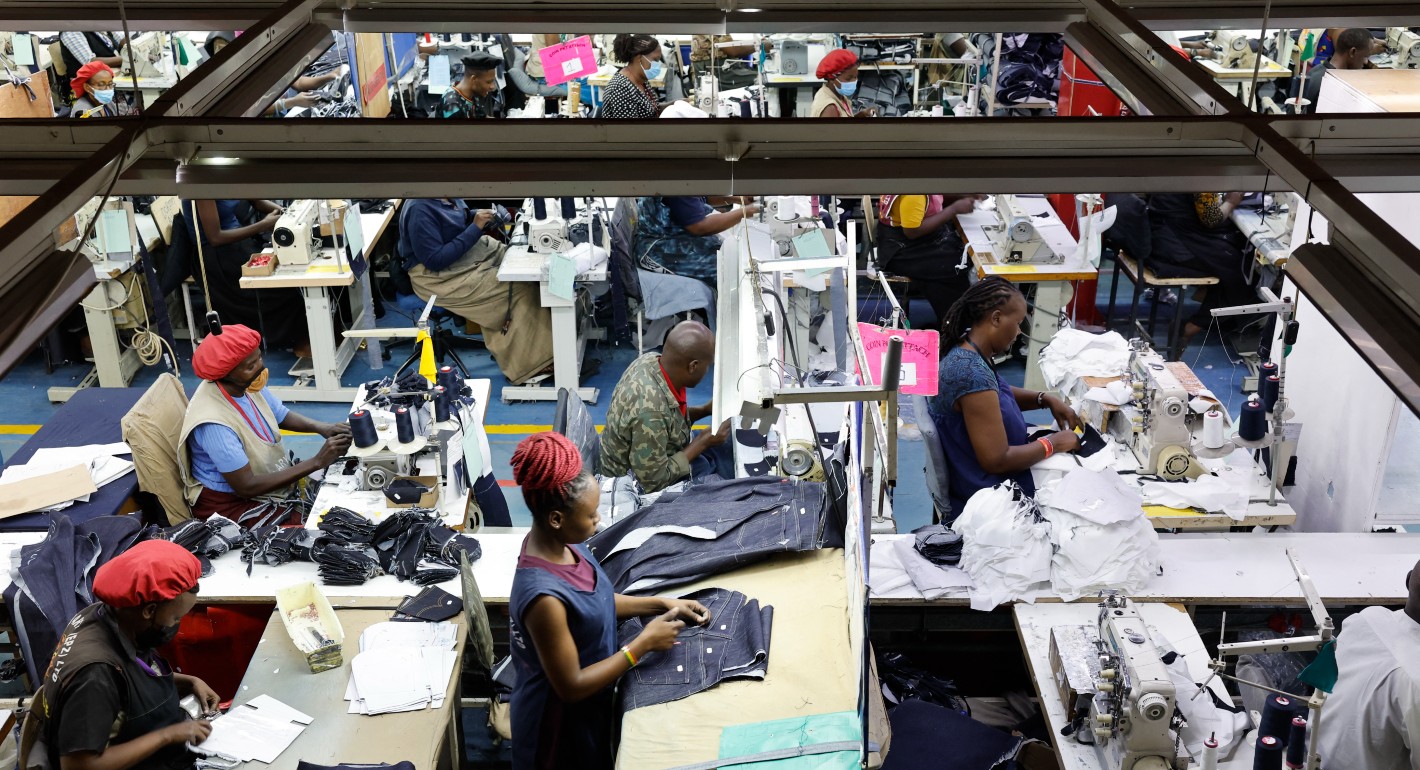
Despite the disappointing state of U.S.-Africa trade over the past two decades, important successes should not be overlooked. AGOA has succeeded in generating meaningful gains in apparel manufacturing and selected industrial sectors in countries such as Ethiopia, Kenya, Lesotho, and Madagascar.15 In several cases, notably in Lesotho, AGOA preferences have helped create formal-sector employment and integrate African producers into global supply chains.16
Finally, but importantly, a singular focus on commodities trade statistics does not capture the full scope of the U.S.-Africa economic relationship and ignores an area where the United States runs a growing trade surplus. Services trade has consistently generated a U.S. surplus since AGOA’s enactment, and this surplus has grown steadily over time. In 2024, U.S.-Africa services trade totaled an estimated $32.9 billion. The same year, U.S. services exports to the continent increased 11.4 percent ($2 billion) from 2023 and the U.S. services trade surplus increased 15.3 percent ($724 million) from 2023, to $5.5 billion.17 In recent years, U.S.-Africa services trade has been dominated by cross-border digital services trade. Simultaneously, U.S. tech companies have established support operations in Africa to leverage lower labor costs, labor availability, and technical skills.18
Trade in services—including financial services, technology, logistics, education, and professional services—is an area of genuine U.S. comparative advantage. It is also an arena where the United States has a national security interest in maintaining and expanding its market share, particularly given intensifying efforts by China and the EU to export their technology services, and the well-documented national security risks of the dispersal of Chinese technology platforms.
Trade in services—including financial services, technology, logistics, education, and professional services—is an area of genuine U.S. comparative advantage.
AGOA’s imminent expiration and the Trump administration’s barrage of sectoral trade actions under the America First trade agenda have clouded the future of U.S. economic relations with African states. Understanding what will happen to U.S.-Africa trade if AGOA is allowed to lapse and how the administration’s various sectoral trade actions impact U.S.-African trade helps frame the strategic stakes.
UN Trade and Development (UNCTAD) has already provided some of the most compelling analysis to date on the implications for U.S.-Africa trade if AGOA is allowed to lapse.19 As the Congressional Research Service notes, AGOA’s main trade preference component is nonreciprocal duty-free treatment of U.S. imports of eligible products from beneficiary countries, which eliminates most-favored nation (MFN) tariffs on eligible imports.20 When AGOA expires, the MFN rate will snap back on all goods that have been entering duty-free. Apparel and textiles carry some of the highest MFN rates in the U.S. schedule. Fuels and minerals will be far less affected, because many of those products already carry very low or zero MFN rates. As UNCTAD notes, small exporters specializing in apparel and processed agricultural products, such as Cabo Verde, Kenya, Lesotho, Madagascar, and Tanzania, will be among the most affected, with average tariffs doubling to 20 percent or higher.
What this analysis makes clear is that letting AGOA lapse would hit hardest in the sectors—like apparel, processed food, and light manufacturing—where AGOA’s original development rationale was actually being realized. In geopolitical terms, this would represent a significant blow to industrialization and export diversification for some of the United States’ most important partners on the continent, particularly Kenya, while limiting the scope for expanding trade with countries like Ethiopia and Tanzania with similar industrialization aspirations.
Section 301 of the Trade Act of 1974 authorizes the USTR to investigate and impose tariffs or other trade restrictions in response to foreign government acts, policies, or practices that are unjustifiable, unreasonable, or discriminatory and that burden or restrict U.S. commerce.
Section 232 of the Trade Expansion Act of 1962 authorizes the president, on the basis of a Commerce Department investigation, to impose tariffs or other import restrictions on products determined to threaten U.S. national security.
Second, the Trump administration’s Section 301 investigations (ostensibly to reconstitute the International Emergency Economic Powers Act tariffs deemed illegal by the Supreme Court) have the potential to significantly alter the scope of U.S.-Africa trade. While USTR’s 301 investigation into industrial overcapacity doesn’t target any African states, its forced labor 301 investigation lists South Africa, Nigeria, and Angola—the first-, second-, and seventh-highest AGOA-eligible exporters to the United States by volume in 2025.21 Imports from these three countries represent over 70 percent of all U.S. imports from AGOA-eligible economies.22 Should the administration proceed with levying Section 301 tariffs on these three economies, it would significantly impact the volume of trade between the United States and the continent.
Third, the administration’s application of Section 232 authorities creates an even murkier picture. Section 232 tariffs have been imposed across several products that directly implicate African exports. The broadest and most immediately damaging are metals tariffs: Steel and aluminum tariffs were increased to 50 percent, effective June 2025.23 A subsequent April 2026 proclamation significantly restructured the framework, applying a 50 percent additional tariff on products of aluminum, steel, or copper; a 25 percent rate on derivative products substantially made of those metals; and a 15 percent combined minimum tariff on certain metal-intensive industrial and electrical grid equipment through December 2027.24 These tariffs hit South Africa the hardest, given its dominant position on the continent in steel and aluminum processing. Automobiles carry a separate 25 percent Section 232 tariff that falls heavily on South Africa’s auto manufacturing industry, and copper carries a 50 percent tariff effective August 2025 that falls principally on the Democratic Republic of the Congo and Zambia (the continent’s leading copper producers). African production of pharmaceuticals is unlikely to be significantly impacted by the Section 232 tariffs, both because it largely serves the continental market and because of the Trump administration’s decision to exempt generic drugs from duties for one year.25
On the other side of the ledger, the administration’s strategic use of trade tools for bolstering critical minerals supply chains (including the Section 232 investigation that authorizes U.S. tariffs) may be a bright spot. Africa’s position as a dominant source of critical minerals is well documented, and USTR has made clear its intent to consider a critical minerals carve-out in the next iteration of AGOA. As such, the administration appears to be positioning Section 232 tariff authority as leverage for bilateral or plurilateral deals with African exporters, rather than a blunt instrument to protect American miners and refiners. For African critical mineral exporters, this creates a fork in the road: Countries that negotiate their way into bilateral or plurilateral agreements with the United States may be able to secure preferential treatment, while those that don’t will remain exposed to punitive U.S. tariffs that could be triggered at the administration’s discretion. This approach demonstrates how the restrained application of tariffs can create incentives for countries to buy into U.S. supply chains and break Chinese chokeholds on critical manufacturing inputs.
Nonetheless, taken cumulatively, if AGOA were allowed to lapse—or suspended in favor of tighter, more coercive eligibility criteria—while 232 and 301 tariffs begin to bite, the impacts on U.S.-Africa trade would be considerable in nearly every product category, outside of minerals extraction.
The strategic environment surrounding AGOA has fundamentally changed since the program’s enactment in 2000. African states today have more external economic partners and more negotiating leverage than at any point in the post–Cold War period. While the United States was a dominant export market for African states thirty years ago, it now faces stiff and diffuse competition from other countries, including Brazil, China, the EU, India, Japan, Türkiye, the United Kingdom, the Gulf states, and African countries themselves.
The enactment of AGOA coincided with China’s economic rise in the early 2000s.26 China has since dramatically expanded its commercial footprint in Africa and, since May 1, 2026, offers nearly universal duty-free access to the fifty-three African countries with which it maintains diplomatic relations.27 The EU has concluded preferential trade agreements with nineteen African countries and regional blocs. India-Africa trade has expanded significantly, with India concluding its first free-trade agreement (FTA) with an African country, Mauritius, in February 2021.28 Additionally, middle powers like the Gulf states, Türkiye, and Brazil continue to deepen their economic engagement across the continent. Currently, the UAE is concluding an FTA with Nigeria;29 Türkiye maintains bilateral FTAs with Egypt, Mauritius, Morocco, and Tunisia;30 and Brazil, through Mercosur, has concluded trade agreements with Egypt and the Southern African Customs Union (Botswana, Eswatini, Lesotho, Namibia, and South Africa).31 These countries have also been increasing foreign direct investment across the continent.32
African states today have more external economic partners and more negotiating leverage than at any point in the post–Cold War period.
In addition to competition from external economic partners, African countries are prioritizing economic relations among themselves under the AfCFTA, which entered into force in 2021.33 Implementation is proceeding slowly and intra-African trade remains under 20 percent.34 However, African policymakers have made clear their preference for trade and development partnerships that support African regional integration rather than detract from it, and have begun creating coordination mechanisms and agreeing on collective negotiating positions.35 Africa’s external investment and trade partners now need to navigate continental structures and enhanced bargaining power, owing to the size and promise of the AfCFTA market.
Congress now has an opportunity to reframe the terms of the U.S. economic relationship with the continent, albeit with precious little time. Trade agreements influence far more than tariffs—they determine how industries position themselves, how supply chains knit together, how regulations converge, where investment flows, and who gets access to which markets. In a competitive trading order, economic integration has become a primary lever of geopolitical influence and commercial resilience. History has shown that countries and firms that establish themselves early within emerging markets tend to capture outsized gains once those economies lift off.
With this backdrop, Congress and the executive branch could consider six priorities to anchor the AGOA reform effort:
First, approach reciprocity through the lens of mutually beneficial negotiations, not front-loaded demands. The administration’s instinct that AGOA should support U.S. exports as well as imports is understandable. But front‑loaded demands for comprehensive reciprocity are likely to be a geopolitical own-goal, running into the reality that most AGOA beneficiaries are simultaneously implementing AfCFTA tariff commitments and managing preferential relationships with a panoply of other partners, while also opening the United States to charges of hypocrisy in light of the numerous section 232 and 301 restrictions detailed above. As such, AGOA 2.0 could consider seeking pathways to reciprocity on high-priority U.S. export sectors rather than up-front demands for across-the-board preferential market access—an approach that the EU has used effectively in its agreements. USTR and the Commerce Department could develop a clear strategy for determining which countries and sectors are the highest priorities for engagement on reciprocity. Congress could require this strategy as a component of regular reviews and oversight, rather than as an a priori condition for eligibility.
Second, create pathways for sector‑specific “side letter” arrangements with African partners on critical national interests, supply chain priorities, and key investment sectors. Side letters are supplementary bilateral instruments executed alongside a primary trade agreement that address discrete issues—sector-specific commitments, regulatory cooperation, or politically sensitive carve-outs—that the parties want to formalize without renegotiating their agreement. They have the legal force of binding government-to-government commitments but allow countries to tailor specific obligations to individual partners, making them a common tool for managing the asymmetries that comprehensive multilateral or plurilateral agreements struggle to accommodate, and have been suggested as a way to better align U.S. priorities with the AfCFTA.36 Critical minerals are a clear priority for such agreements. Not only could side letters provide a pathway for specifical critical minerals agreements, but they could also create trade incentives for investments in processing and refining capacity, not merely extraction—an area where U.S. supply‑chain resilience interests converge with African industrialization interests.
Critical minerals should not be the only priority. Side letters on services, manufacturing inputs, infrastructure, agriculture, and energy could address bilateral tariff and non-tariff issues without holding the broader preference program hostage to lengthy eligibility reviews or slow, comprehensive FTA negotiations. Used in the context of the full slate of sectoral tariffs, negotiations on side letters could also open pathways to Section 232 tariff relief. This layered approach would help resolve the AGOA graduation conundrum: Instead of pushing successful beneficiaries off AGOA toward unattainable comprehensive bilateral FTAs (to date the United States has only negotiated one FTA with an African partner—Morocco), the United States can preserve the strategic relationship by transitioning them into mature, sector‑specific arrangements.
Third, recalibrate eligibility criteria and suspension procedures with an eye to consistency, transparency, and proportionality. AGOA’s legacy eligibility framework—which requires that beneficiary countries have a market‑based economy, rule of law, political pluralism, worker rights, anti‑corruption enforcement, and no actions undermining U.S. national security—is normatively defensible. The problem is not the substance of these criteria; it is their inconsistent application, the political pressure that has produced both selective enforcement and selective leniency, and an all‑or‑nothing suspension mechanism that produces disproportionate consequences. Madagascar’s 2009 suspension cost an estimated 50,000–100,000 apparel jobs; Ethiopia’s 2022 removal cost over 10,000 jobs. In both cases, suspension did little to change the actions of the governments responsible, and in Ethiopia’s case, removal became a major propaganda victory for the Ethiopian regime.
Congress and the executive branch could consider a twofold fix: Publish objective, transparent indicators for each eligibility criterion, and replace the binary suspension mechanism with a graduated menu of options—including reinstatement of sector‑ or product‑level duties—to preserve and target the U.S. negotiating leverage. This would give the United States the ability to target sectors specifically tied to the state or other national priorities (such as state-run energy conglomerates) without unduly harming private-sector enterprises, laborers, and farmers who bear little responsibility for their governments’ actions.
Fourth, ensure that eligibility supersedes Section 301 forced labor tariffs. Congress has already designed tools to address forced labor concerns—and Section 301 isn’t one of them. AGOA’s statutory eligibility already requires beneficiary countries to establish (or make continual progress toward establishing) protection of internationally recognized worker rights; for instance, Trump terminated Mauritania’s AGOA eligibility over forced labor in November 2018. Using Section 301—a statute aimed at unfair foreign trade practices that burden U.S. commerce—to address a beneficiary country’s third-country supply chain compliance is a categorical mismatch. It bypasses the eligibility framework Congress built for this problem and ignores the fact that AGOA is already more proportionate, more targeted, and more deliberative than a blanket Section 301 tariff.
Forced labor in third-country inputs—such as fabric sourced from a non-AGOA country or components shipped through a regional supply chain—is a supply chain integrity problem, not a measure of whether an AGOA partner is failing its workers. The United States already has tools that target that problem directly without punishing entire African economies: Section 307 of the Tariff Act of 1930 authorizes U.S. Customs and Border Protection to issue withhold release orders against shipments produced with forced labor anywhere in the world, and the Uyghur Forced Labor Prevention Act establishes a rebuttable presumption against goods with inputs from Xinjiang regardless of where they are assembled.37 These instruments are more effective mechanisms for addressing forced labor in complex supply chains than countrywide tariffs that punish governments and businesses in Africa for the actions of countries that they are not responsible for and can’t meaningfully regulate.
Fifth, adopt rules of origin that create incentives for intra-African supply chains via AfCFTA implementation. Third-country fabric provision and bilateral cumulation have been essential to gains in the continent’s apparel sector and represent important planks of the legislation. However, AGOA’s rules of origin could be tightened to require higher minimum value-add thresholds, preventing third-country products from accessing U.S. markets at preferential rates through minimal African processing. While the 35 percent regional value content is already high for some African countries, to meet a higher threshold, the United States could explicitly permit cumulation in African beneficiary countries that are members of the AfCFTA. Stronger enforcement and cumulation rules that enhance African regional integration could modernize AGOA, without eliminating the flexibility that has made AGOA meaningful for the African textile sector.
Sixth, integrate AGOA 2.0 with a rebuilt U.S. economic assistance and financing toolkit. USAID was one of the agencies most aligned with AGOA, supporting regional trade and investment hubs that provided technical assistance and training to increase export competitiveness and channeling resources to private sector partners looking to take advantage of AGOA preferences. Rebuilding these programs, as well as the interagency platform for facilitating two-way trade and investment (Prosper Africa) that was jettisoned during USAID’s ill-conceived dissolution, would be a meaningful first step toward more actively facilitating effective AGOA utilization across the continent. In addition, channeling financing from the U.S. Development Finance Corporation and Export-Import Bank toward priority sectors covered by side‑letter agreements, as noted above, would create a coherent set of trade and investment incentives where they are currently fragmented.
A U.S. trade regime that prioritizes punitive conditionality over predictable partnership will rapidly accelerate the decline of U.S. economic influence.
The administration and Congress have a landmark opportunity in the months ahead: They can choose to pursue AGOA modernization not as a narrow exercise in tightening conditions or maximizing leverage, but as a critical pillar within a comprehensive strategy for building African linkages with the U.S. market and U.S. supply chains at a moment when the economic alternatives are increasingly attractive. A modernized AGOA that creates pathways for strategic reciprocity, sectoral cooperation, stronger but more flexible enforcement mechanisms, and integrated investment support could strengthen U.S.-Africa economic ties while advancing core American commercial and geopolitical interests. Conversely, a U.S. trade regime that prioritizes punitive conditionality over predictable partnership will rapidly accelerate the decline of U.S. economic influence.
The Trump administration has built its America First trade policy around the proposition that previous administrations gave away too much. That argument carries more force in other parts of the world, but in Africa, the United States is faced with an inverse problem: A generation of U.S. policymakers has consistently underinvested in the continent that, by any honest accounting, will be one of the most consequential growth stories of the twenty-first century. Reforming and enacting a new AGOA is an opportunity to correct course before that window closes. The cost of squandering it will not be measured in balance of trade accounting; it will be measured in market share, supply chain resilience, and strategic partnerships that, once fully ceded, will not be easily recovered.

Nonresident Scholar, Africa Program
Tyler Beckelman is a nonresident scholar with the Carnegie Endowment for International Peace’s Africa Program. His work focuses on commercial diplomacy and trade and investment policy.

Nonresident Scholar, Africa Program
Kholofelo Kugler is a nonresident scholar in the Carnegie Africa Program.
Carnegie does not take institutional positions on public policy issues; the views represented herein are those of the author(s) and do not necessarily reflect the views of Carnegie, its staff, or its trustees.

Middle powers in the region will keep hedging between Washington and Beijing. It’s in the great powers’ interests to play along.


Amr Hamzawy, Kathryn Selfe
The future of American economic power will be determined by the interplay between Trump’s ambitions and the global backlash against them, as well as economic developments outside the direct control of the government, such as advances in AI.

Peter Harrell
Russia looks set to reap economic benefits from closer ties with Southeast Asian countries that are keen to find reliable energy suppliers and diversify trade ties.

Alexander Gabuev
To carry out its global AI agenda, Washington will need strategic relationships with emerging markets in Africa, starting with Kenya.

Jane Munga

Europe’s industrial supply chains leave it vulnerable to global shocks. The EU needs a pragmatic green industrial strategy that balances durable partnerships and bolsters homegrown clean tech without sacrificing low-carbon ambition.


Milo McBride, Pauline Gerard